
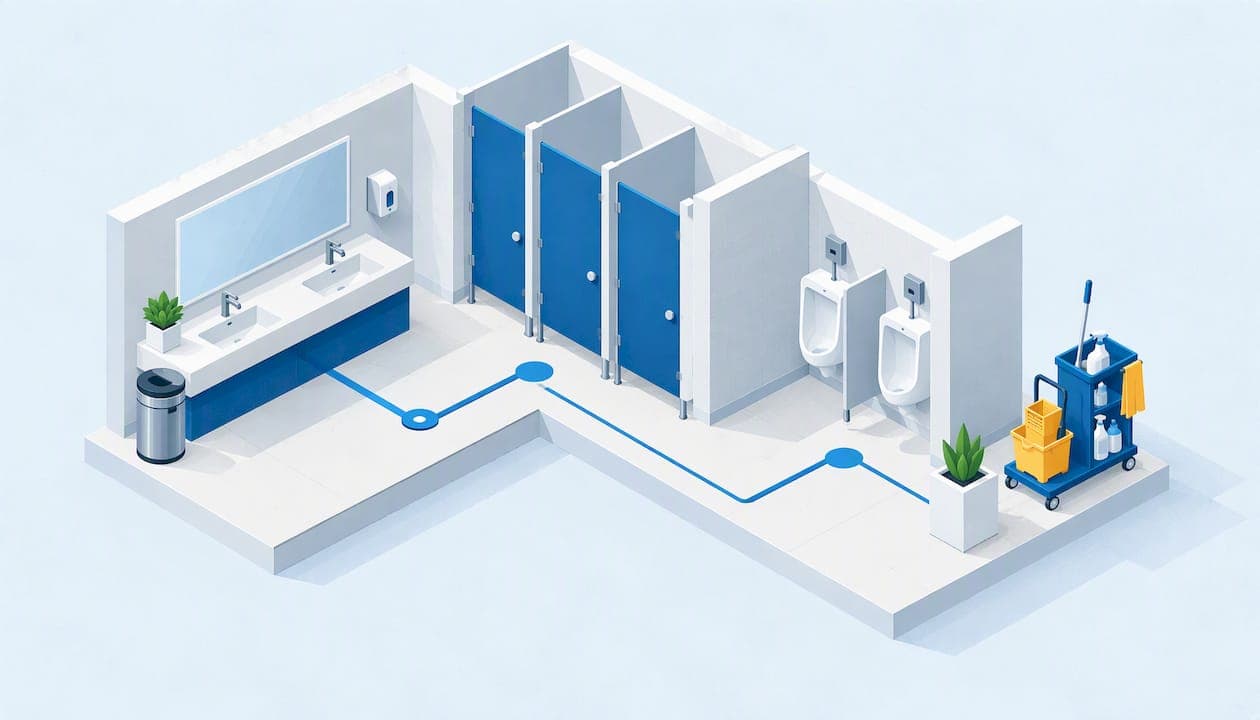
Commercial restroom cleaning is a scheduled service that cleans, disinfects and restocks the toilets, basins, floors and fittings your staff and visitors use. How often it runs depends on how many people use the facilities and what kind of building you operate. In Australia, your obligation to keep these facilities clean and safe comes from work health and safety law, so the schedule is more than a courtesy. Below you will find what a good service includes, how to set the frequency, what affects the cost and how to check the work is being done.
TL;DR
- A proper restroom clean covers more than the toilet: surfaces, high-touch points, floors, bins, dispensers and restocking, in a fixed order from top to bottom.
- Frequency is set by use, not habit. Safe Work Australia's model code points to the type of work, likelihood of contamination, number of users and shift work.
- Clean first with soap or a general-purpose cleaner, then disinfect high-touch points and respect the product's contact time.
- Cost is mostly labor, and weekend, public holiday and early or late shifts cost more under the national cleaning award.
- Ask any provider for a written task list, a reporting process for faults and empty stock, and who actually turns up.
Table of Contents
- What commercial restroom cleaning includes
- The order of work matters
- How often should restrooms be cleaned?
- What Australian workplace rules expect
- What affects the price
- Our perspective: consistency is the real product
- Setting up a schedule and quality-control process
- Restrooms in different types of premises
- Restroom cleaning with Blue Cleaning Group
- FAQ
- Sources
What commercial restroom cleaning includes
A restroom clean at a workplace is a defined set of tasks, not a quick wipe and a mop. A written scope should name each of these:
- Toilets and urinals: bowl, seat, hinges, underside of the rim, cistern and flush handle, and the surrounding floor and wall.
- Basins and benchtops: basin, taps, soap dispenser, splashback and the bench the basin sits in.
- High-touch points: door handles, push plates, lock latches, light switches, flush buttons and tap handles.
- Mirrors and glass: smears and splashes, plus partition panels.
- Floors: swept or vacuumed, then mopped with an appropriate product, including edges and behind the toilet.
- Bins and sanitary disposal units: emptied, wiped and relined.
- Restocking: soap, toilet paper, paper towel and hand sanitizer.
- Showers and change rooms where your site has them.
Restocking is not a minor extra. Safe Work Australia's model code of practice on managing the work environment says consumables such as soap and toilet paper should be replenished regularly to keep facilities clean and safe. A restroom with a spotless bowl and an empty soap dispenser has still failed.
The order of work matters
Most cross-contamination in a restroom comes from the cleaning method, not the lack of effort. Health guidance from the Minnesota Department of Health, written for public restrooms, sets out a sequence that holds up for any commercial site. It recommends cleaning with soap and water or a general-purpose cleaner before disinfecting, and working from top to bottom. The targeted disinfection then goes on high-touch areas such as flush handles, faucet handles, door handles and countertops.
In practice, a sound routine looks like this:
- Put up a wet-floor sign, restock the cart and put on gloves and any other PPE the site requires.
- Remove rubbish and empty the bins.
- Apply cleaner or disinfectant to toilets and urinals so it can sit while you work elsewhere.
- Clean mirrors, benchtops, basins and taps, working from top to bottom.
- Disinfect the high-touch points, leaving the product wet for the time on its label.
- Scrub and flush the toilets and urinals.
- Mop the floor last, from the far corner back toward the door.
- Restock consumables and check for faults.
Some cleaners use a pacing idea, often called the 5-5-5 rule, which splits a bathroom into three short blocks: toilet and shower, basin and surfaces, then floor. It is a pacing aid popular in home cleaning, not a standard, and a busy commercial restroom needs more time than that. What carries over is the order, not the stopwatch.
Contact time and chemical safety
A disinfectant that is wiped off straight away has not disinfected anything. The same Minnesota guidance says to follow label directions, including the specified contact time. It also says not to mix cleaning products and disinfectants unless the labels say it is safe. Mixing products is how cleaners end up with fumes in a small, poorly ventilated room, so a competent provider uses one product system and trains staff in it.
How often should restrooms be cleaned?
There is no single number that suits every business. Safe Work Australia's model code of practice says workplace facilities should be cleaned regularly. It says the schedule should take account of the work performed, the likelihood of contamination, the number of workers using the facilities (including shift work) and the type of facility, such as toilets, handbasins and showers.
For a sense of scale, a university facilities chart from the United States, FIU's 2015/16 custodial task frequency chart, lists restroom cleaning and restocking twice daily. That is an American campus, not an Australian requirement, but it shows how high-use facilities are commonly treated.
To turn the principles into a schedule, use this as a starting point and adjust it to your site:
| Type of site | Typical starting pattern | What pushes it up |
|---|---|---|
| Small office, under 20 staff | Daily clean after hours | Visitors, shared kitchen use, a single toilet |
| Larger office or multi-tenant floor | Daily clean plus a midday check and restock | Many users, client-facing reception |
| Retail or showroom with public access | Daily clean plus one or more attended top-ups | Customer foot traffic, weekend trade |
| Warehouse or industrial site | Daily clean, sometimes per shift | Shift work, dirt and grease on hands and boots |
| Childcare or education | Daily clean plus mid-day attention and disinfecting | Young children, higher hygiene expectations |
| Strata common areas | Several visits a week, set by building use | Number of residents, visitors and trades |
These patterns are our own working starting points, not a regulatory table. The test is simple: if the room looks or smells poorly kept before the next clean, the schedule is too thin for the traffic.
What Australian workplace rules expect
Cleaning restrooms is part of how a business meets its duty to provide a safe work environment. The December 2025 version of the model code says workplaces must be maintained in a clean and safe condition. It also says the business should provide suitable cleaning and disinfecting products, and the necessary PPE at no cost to the worker when PPE is a reasonably practicable control, and train workers to use them.
Two practical consequences follow:
- If your own staff clean the restrooms, you need to supply the products and PPE, and show people how to use them. Asking someone to bring their own gloves does not meet the standard.
- If you hire a contractor, the contractor carries duties for its own workers, and you still have a responsibility for the workplace. Ask what training and PPE the provider supplies, and be clear about the site hazards.
On PPE, Safe Work Australia's control measures guidance states that when PPE is identified as a reasonably practicable control, the business must provide it at no cost, and the worker must use it as instructed. The same page says workers should wash their hands after removing PPE and after work activities where exposure may have occurred. Both points apply to restroom cleaning whatever the pandemic situation.
The model codes are a template, and each jurisdiction adopts its own version into law. For a Canberra business, check WorkSafe ACT for the current ACT position before you write procedures around a clause.
What affects the price
Most of what you pay for restroom cleaning is labor, so the cost drivers are about time and timing:
- Number and size of restrooms. More fixtures mean more minutes per visit.
- Visit frequency. Daily costs more than three times a week, though often less per visit.
- When the work happens. The Fair Work Ombudsman's Cleaning Services Award 2020 applies nationally to the contract-cleaning industry. Its penalty-rate table sets higher percentages for early or late weekday shifts, Saturdays, Sundays and public holidays, and those add to the labor cost of a schedule.
- Condition and use. A restroom used by a site crew carries more soil than one used by a few office staff.
- Consumables. Some providers include soap and paper, others charge them separately. Ask which applies.
- Specialist extras. Periodic deep cleans, descaling, floor and grout work, or disinfecting programs are priced separately from the routine visit.
A very cheap quote for a late-night clean usually means something has been left out of the scope, or the provider is not meeting its wage obligations. Ask what the quote assumes about shift times and what is excluded. Our own page on cleaning prices in Canberra shows how we publish pricing, and our guide to how we quote office cleaning explains what we look at on a site visit.
Our perspective: consistency is the real product
We clean restrooms in offices, warehouses, shops, childcare centers, strata buildings and construction sites around Canberra. The most common complaint we hear from businesses that switch to us is not a dramatic failure. It is inconsistency: a good clean on Monday, a missed dispenser on Wednesday, a different person each week who has not been shown how your site works.
That is why we employ our cleaners directly and train them in our own systems, rather than passing work along to a chain of subcontractors. When one person is accountable for a site, and the same familiar face turns up each visit, small faults get reported and fixed. A cleaner who knows your building notices the tap that is starting to drip and the dispenser that keeps running out before anyone complains.

We are ISO 9001 accredited, which means our quality processes are audited against a recognized standard. For restroom work, that shows up as a written task list per site, a fixed order of work, and a clear route for reporting faults. We suggest every business writes down the same three things, whoever it hires.
If you want to see how we set up a contract, how our commercial cleaning contracts work lays it out.
— User
Setting up a schedule and quality-control process
A good provider gives you a plan, and a good client reads it. Check these points in any restroom cleaning agreement:
A written scope per restroom
The task list should name each room and each task, with the frequency. "Toilets cleaned" is not a scope. "Toilets, urinals and seats cleaned and disinfected daily, high-touch points disinfected daily, floors mopped daily, deep descale monthly" is.

A reporting process for faults and stock
The Minnesota guidance says restroom programs should define how maintenance issues are reported, such as leaking fixtures, vandalism and empty supply inventory. Agree who the cleaner tells, how, and how fast something is fixed. A cleaner who sees a blocked toilet and has nowhere to report it will simply leave it.
A way to check the work
Walk the restrooms yourself during the first month. Look at the base of the toilet, behind the door, the underside of the seat, the taps and the corners of the floor. A simple sign-off sheet inside the room, or a periodic inspection report from the provider, gives you a record to point to.
Clear answers about people and products
Ask who will clean your site, whether they are employees or subcontractors, how they are trained, and what products they use. Ask what happens if a visit is missed or the standard slips.
Insurance and site access
Confirm the provider carries insurance appropriate to your site and how keys, alarms and after-hours access will be handled.
Restrooms in different types of premises
Offices
Office restrooms are usually cleaned after hours on a daily schedule, with the focus on keeping stock up and surfaces fresh for the next morning. Our office cleaning service folds restrooms into the full scope, along with kitchens, desks and floors.
Warehouses and industrial sites
Shift work and heavier soil change the schedule, and amenities often need attention more than once a day. See our warehouse and industrial cleaning page for how we handle larger sites.
Childcare and education
Hygiene expectations are higher and contact surfaces matter more. Our childcare and education cleaning and disinfecting and sanitizing services are built around that.
Construction sites
Site sheds and amenities need regular attention while a project is running, and a full clean at handover. Both are covered on our construction cleaning page.
Restroom cleaning with Blue Cleaning Group
We provide scheduled restroom cleaning as part of our commercial cleaning in Canberra, for offices, strata, warehouses, shops, childcare centers and building sites. Our cleaners are directly employed and trained in our systems, and you can see how we price on our prices page. To discuss a site, start from our Canberra cleaning home page and tell us how many people use the facilities and when you need the work done.
FAQ
How often should a commercial restroom be cleaned?
There is no fixed figure. Safe Work Australia's model code says the schedule should reflect the work performed, likelihood of contamination, number of users, shift work and facility type. A small office may need a daily clean, while a busy shopfront or a shift-based warehouse may need attention more than once a day.
How do you properly clean a public restroom?
Clean surfaces with soap and water or a general-purpose cleaner first, then disinfect the high-touch points, working from top to bottom and mopping the floor last. Follow the product label for contact time and never mix products unless the label says it is safe. Wear the gloves and any other PPE your site requires, and wash your hands afterward.
Who is responsible for supplying PPE and cleaning products?
Under Safe Work Australia's model code, a business must provide suitable cleaning products and, where PPE is a reasonably practicable control, provide it at no cost to workers and train them to use it. If you hire a contractor, ask what it supplies for its own staff. For the position in the ACT, check with WorkSafe ACT.
Why do quotes for restroom cleaning vary so much?
Labor is the main cost, and it changes with the number of fixtures, visit frequency and the time of day. Early, late, weekend and public holiday work attracts higher rates under the Cleaning Services Award 2020. Quotes also differ on whether consumables and periodic deep cleans are included, so compare scopes, not just totals.
Sources
- Safe Work Australia: Model Code of Practice, Managing the work environment and facilities (2011 version)
- Safe Work Australia: Managing the work environment and facilities (November 2024)
- Safe Work Australia: Managing the work environment and facilities (December 2025)
- Safe Work Australia: Control measures
- Minnesota Department of Health: Cleaning and Disinfecting Public Restrooms (2018)
- FIU Facilities: Custodial Services task frequency chart (2015/16)
- Fair Work Ombudsman: Cleaning Services Award 2020 [MA000022]